

The Münchner Stadtmuseum notes that this article discusses visual and textual sources that depict discriminatory power dynamics. The images and texts represent contemporary perspectives from which we distance ourselves. At the same time, we feel a responsibility to provide the interested public with access to these sources in order to facilitate a critical engagement with the historical material. Some of the original titles in this article contain contemporary racist language and are marked with quotation marks. Some photographs are blurred.
Two meticulously assembled photo albums, two handwritten diaries containing detailed descriptions of trips and family history and illustrated with photos: Adolf Klöpfer left behind an oeuvre that was as personal as it was societally relevant. Part of the Photography Collection, his photo albums tell the story of European travelers and immigrants in the late nineteenth and early twentieth centuries. The intention, form, and content of Klöpfer’s albums may be fruitfully examined when placed into a comparison with the private photo albums of the married couple Mathilde and Heinrich Baist, as well as the album created on commission by professional photographer Samuel Boote.

Alternative Approaches in Travel Albums Held by the Photography Collection: Works by Heinrich and Mathilde Baist and Samuel Boote
The exhibition Knipser. Zur Geschichte der privaten Fotografie in Deutschland und Österreich 1880–1980 (Shutterbugs: On the History of Private Photographs in Germany and Austria, June 14 to August 20, 1995). Timm Starl, a Vienna-based photohistorian and curator of this exhibition series, had previously written an article on the topic and on a unique exemplar of this genre in 1993, in an issue of the periodical Fotogeschichte. Geschichte und Ästhetik der Fotografie. This was a collection of works from Heinrich and Mathilde Baist, a married couple, which entered the Photography Collection at Münchner Stadtmuseum thanks to Starl in 1994/95.[1] These comprise thirty-eight albums and other items containing photographs (envelopes, folders, and boxes made of wood, leather, or paper) dating from between 1910 and the 1960s, all taken by the Baists: Heinrich Reinhold Baist (1889–1938) and Mathilde Baist (née Leschhorn, 1897–1964).[2]

These amateur albums include photographs by Heinrich Baist dating to the era of the German colony "Tsingtao" (Qingdao, China), his time as a prisoner of war in Japan, as well as photographs of his and Mathilde’s joint travels following their marriage in 1921. Like Klöpfer, the Baists spent time as émigrés and brought together their own photographs with those of professionals which they purchased. They were members of the German community in „Kanton” (Guangzhou), China between the 1920s and the 1940s.[3] Their albums chronicle their residences, acquaintances, excursions, Chinese festivals such as the Dragon Boat Festival, as well as German celebrations abroad including Carnival and Oktoberfest.
Originally intended for private use, these albums now reside in the museum collection as witnesses to everyday social and photographic history. They offer an intimate glimpse into German émigré life - which was significantly characterized by contact with the local cultures and people - while capturing a collective time-bound experience—that of a mobile middle class who sought their fortune abroad in the early twentieth century. As photography became more widely accessible, such private albums morphed into pieces of hybrid media at the intersection of personal memories and documentary witnesses to history.[4]
In contrast, Samuel Boote (1844–1921) was a professional photographer. He was born in Argentina to English émigré parents; from the 1870s onwards, he documented how his homeland transformed. His album Vistas de Escuelas Comunes (Views of Municipal Schools) was commissioned by the ministry of culture in 1888. It comprised forty-one photographs on albumin paper of school buildings, schoolyards, and school processions in Buenos Aires. To this day, the lavish album is held by many international collections. It was presented at the 1889 World’s Fair in Paris, where it served to depict Argentina to an international audience as a progressive nation after the European model.[5]
The schools represented modernization but also the suppression of the Indigenous population. In one classroom, one can see the sentence "Paris es la capital del mundo civilización" written on a blackboard—a tenet that quite literally inscribes a Eurocentric view of civilization.[6] Thus Boote’s photographs were instrumentalized to serve colonial visual politics, perpetuating a contrast between the supposedly "civilized" center of Buenos Aires and the "primitive" back country of Argentina.


Taken together with Klöpfer’s work, these three holdings give voice to the different narratives found in travel albums of the late nineteenth and early twentieth centuries. Whereas Boote documented his homeland, the Baists and Klöpfer depicted regions and countries beyond the land of their birth—and this across two centuries. Yet the albums of all three photographers speak to a Eurocentric perspective—even that of Boote, a second-generation immigrant from Argentina.
Between Intimacy and Exposition: Album Formats and Structures
Even in formal terms, there exist distinct differences between the albums of the Baists, Klöpfer, and that of Boote. Mathilde and Heinrich Baist did not follow any particular rigid system when ordering their photographs. Instead, their albums often brought together various forms and motifs by numerous photographers. Within exhibition curation, this form of display is known as a salon hanging and gives rise to many different interpretive possibilities: the photographs are not arranged according to a strict chronology. Rather, they exist in a fluid interrelationship influenced by each viewer’s unique understanding and foreknowledge. Yet difficulties arise in following the narrative structure of a family album, seeing as we often lack necessary contextual knowledge.[7] In contrast, each of Boote’s photographs is centered on a single page in the album and given a title, enabling a clear and cohesive understanding.


Whereas the Baists used albums with different formats and bindings (silk, linen, leather, synthetic materials, and cardstock), Boote’s albums are distinguished by their size, heavy leather binding, and the raised gold embossed details. In contrast, Klöpfer’s albums site themselves precisely between the two in their binding, size, and ordering of photographs. You will find more information on Klöpfer’s photo albums in the essay In Focus: Adolf Klöpfer and Münchner Stadtmuseum.
Constructing Eurocentric and Colonial Narratives in Photography
The aforementioned photo albums evince the prevailing understanding of photography in the late nineteenth century as a documentary medium offering an objective depiction of reality. Photography became a powerful form of evidence at the intersection of the pursuit of scientific objectivity and social construction. For instance, it was used for anthropometric surveys examining members of colonized people groups in ethnology and criminal anthropology. Only later was photography understood to function as a means of reflecting social power dynamics and as a medium for subjective interpretation.[8] Both Klöpfer’s and Boote’s photographs showed the faith that the newly founded nation of Argentina held in the idea of progress. Schools, government buildings, and cityscapes were intended to make the country’s strides toward modernization after a European model internationally visible, such as at the World’s Fair in Paris in 1889. Klöpfer himself described this impression of Western urbanism in his diary:
"Life in Buenos Aires is indescribably grand: only few Europeans could boast of streets so full of coaches, equipages, and horse-drawn tram cars."[9]


The Photo Album—a Collection within a Collection as a Subject of Research
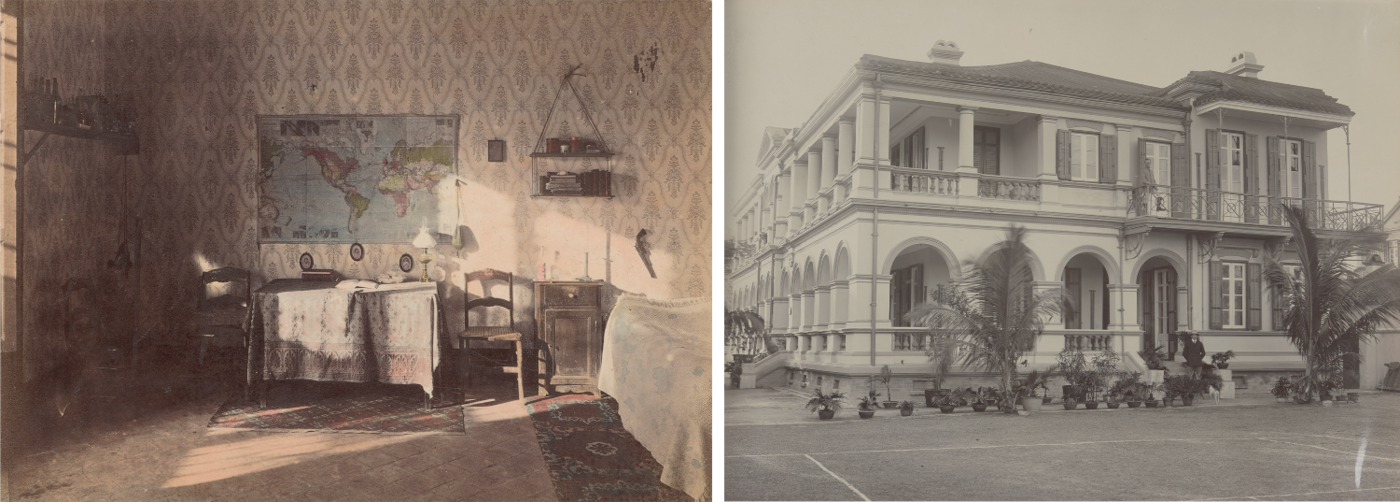
Alongside these symbols of progress, Klöpfer’s first album also contains photographs of presumably Bolivian Indigenous persons: these are staged, anonymous, and often bear colonial labels such as "Eingeborene von Potosí".[10] The German term "Eingeborene" (meaning "natives" in English) reproduces a hierarchical world view wherein a diversity of Indigenous lives and identities are elided while the colonial order is reinforced. Some of the studio photographs show individuals with apparently bare torsos bearing bows and arrows against a European studio backdrop, whereas others depict individuals in traditional dress such as ponchos and hats. These constructed visual tropes evoke a romanticized ideal of the "noble savage".[11]


[1]
Klöpfer’s own photographs document everyday life and the infrastructure of his surroundings abroad, but he also collected photographs taken by others as souvenirs of his travels. This practice of collecting photographs was not unusual among European travelers. There was an extensive photo industry in Asia, Africa, and South America, offering supposedly "typical" depictions of the region and people in question. These photo studios—mostly established by European immigrants and continued on by local photographers—thus catered to European perspectives, which would then be disseminated back in Europe, together with the photographs.
This juxtaposition of travelers’ unique perspectives against purchased photographs largely commissioned for the travelers and catering to the aforementioned narratives—rather than to an objective portrayal of the region and people —yields a hybrid and profoundly subjective view of South America that lies somewhere between observation, appropriation, and distance. Hinnerk Onken notes that such collections of photographs reveal the ambivalence underlying the South American worldview: photographs of railways, harbors, and government buildings are placed alongside photographs of Indigenous persons, the pampas, and ruins. At first glance, this comparison seems to evoke a clear dichotomy between modernity and tradition, "civilization and barbarism".[12] Yet on closer examination, an interstitial realm of hybrid meanings emerges whose sense oscillates depending on context—between admiration and arrogance, proximity and distance. Klöpfer’s photographs move precisely along this tense axis between poles, showing how colonial narratives are visually reinforced and yet undermined through ambivalence.[13]


This ambivalence can also be seen in the contemporary frontier ideology described by Idurre Alonso and Judith Keller as a central figure of thought for an understanding of nineteenth-century Latin American expansionism.[14] Analogous to the mythology of the frontier in the United States, the so-called "conquest of the desert" in Argentina legitimized the military conquest and „civilization” of Indigenous regions. The suppression of Indigenous peoples was presented as a necessary precondition of progress: an idea reinforced in visual media, maps, and photographs. The absence of Indigenous persons of Argentina in Klöpfer’s photo albums, as well as the depiction of European infrastructure in the so-called "foreign land", reflect precisely this ideological separation of civilization and nature.[15]
This form of photographic Othering entails a symbolic and structural construction of the Other that also boosts the colonizer’s self-regard.[16] It is seen not only in the depiction of Indigenous persons, but also in the architecture and urban planning projects undertaken according to a European model, and in the documentation thereof. In this, the power imbalance between the original inhabitants and the privileged émigrés is shown visually and made perceptible.
Back in 1990, Münchner Stadtmuseum dedicated an exhibition to the construction of a European and colonial worldview through allegedly documentary photography in an ethnographic context under the title Der geraubte Schatten. Das Bild fremder Kulturen in der westlichen Photographie, working in cooperation with the House of World Cultures, Berlin. The exhibition was the first to gather photographs held across ethnography collections in Germany and examine the colonial processes of knowledge production tied to them, as well as their visual mechanisms. Even today, the exhibition is regarded as a key benchmark in engaging with ethnographic photography collections. Though the Photography Collection at Münchner Stadtmuseum is not an ethnographic collection of images per se, many of the photographs held in albums, as well as individual prints, were taken outside of Europe and speak to a colonialist visual regime, created as they were in a context of imperial power relations.

[2]
A similar tension is seen in the Baists’ China albums. They juxtapose everyday scenes of émigré life—festivals, excursions, friendships—and photographs of what was foreign to them: temple complexes, cityscapes, and racialized 'types'. According to Timm Starl, these photographs document a "two-fold decentrification": the Baists bring together images of their everyday lives in the German community with photographs of Chinese life, thus constructing the colonizer’s gaze. A photograph featuring Heinrich Baist himself in front of a villa, titled "Messe Baist, Lyemoon Villas, Kowloon" clearly illustrates his documentary view of his work—the mention of his own name in the title is another proof of his presence at the scene—whereas his disparaging caption, "This is how the mob eats" for a photograph of four men who appear to be of Chinese descent at a dining table, reveals a European arrogance.
Thus the photo albums of Mathilde and Heinrich Baist, Samuel Boote, and Adolf Klöpfer exemplify the creation and dissemination of Eurocentric and colonial narratives in photography.


Authorship of photo-albums: Photographer or Collector?
This material raises questions around authorship in photography. Is the photographer the individual who released the shutter? Can one speak of a collective authorship when the photographers appear in their own images, as happens in Klöpfer’s and the Baists’ albums? In both cases, one cannot know who composed or took the picture.
Assembling the albums forms a further dimension of collective authorship. In them, original and purchased photographs are brought together to form a new narrative whole. A new and unique visual self-image results through these acts of selecting, ordering, and contextualizing. Thus the album compiler becomes an author of a new and subjective document, even if some of the photographs have been taken by others.
It is thought that personal preferences guided Klöpfer’s and the Baists’ selection of images, whereas Boote, a professional photographer, was led by an institutional agenda. Taken together, the latter’s images of buildings framed as monuments—often on uncultivated ground—presented an image of a powerful center of "civilization". The rigorously composed photographs of schools and groups were most likely selected for this national document by a committee composed of more people than just the photographer himself.
Individual photographs in Klöpfer’s albums can be credited to specific photographers with certainty. For instance, a genre portrait of an Indigenous person in his first album is also held by another German museum collection: it is part of the papers of German traveler Wilhelm Joest held by Rautenstrauch Joest Museum in Cologne, where the same individual is portrayed as part of a set of cartes-de-visite against the same backdrop and with the same props, albeit standing in a slightly different position. This coincidence reveals parallels between the two travelers—who both purchased photographs from the studio as part of their attempt to explore South America—while also highlighting a structural problem inherent in how museums catalogue photo albums. If the album had been inventoried as a single object, as is typical for many collections, the individual images would neither have been recorded nor digitalized. This would have led to this connection going undetected. In contrast, the Photography Collection at Münchner Stadtmuseum views photo albums through the lens of the individual images and the sites of these photographs. Thus, each photograph, whether loose or mounted in an album, is assigned a unique inventory number which allows it to be located and identified. This is primarily relevant in travel and souvenir albums that collect images by a number of authors and can only be searched if inventoried in this manner. Yet the question of how photo albums are recorded is relevant not only in the archives, but also in the exhibition galleries: how can original photographs be shown in albums without damaging the larger container and losing context along the way? Where does the focus lie: on the presentation of the photo album as material object, the individual photographs within the album, or on the collectors—who in some cases also took the photographs included? The complexity of the questions associated with photo albums presents significant challenges to photography collections.
Endnotes
[1] Timm Starl, "'Knipsen' Private Fotografie in Deutschland von 1900 bis heute", Fotogeschichte 13, no. 50 (1993).
[2] The albums from 1909 to 1943 alone include around 4,500 photos taken by the Baist family and 850 photos from photo businesses. 26 of these albums show scenes outside of Europe, while the rest depict holidays and voyages within Germany and Europe.
[3] “Kiautschou” was the name of a territory in China that was leased to the German Empire between 1889 and 1914, with its capital “Tsingtau” (actually Qingdao).
[4] Cf. Timm Starl, Knipser. Die Bildgeschichte der privaten Fotografie in Deutschland und Österreich 1880–1908 (Marburg: Jonas Verlag, 1995).
[5] It was exhibited, for example, at Getty Research Institute and at Instituto de Arte Americano e Investigaciones Estéticas Mario J. Buschiazzo, a scholarly institution that is part of the Faculty of Architecture, Design, and Urbanism at the University of Buenos Aires, https://www.iaa.fadu.uba.ar/?page_id=12892 (accessed 24.10.2025).
[6] Vgl. Alonso, Idurre: Expertinnentext Samuel Boote, in: Schönegg, Kathrin (Hg.): Artists on Photography. Außereuropäische Reise- und Souveniraleben in der Sammlung Fotografie des Münchner Stadtmuseums, Leipzig, 2026
[7] Bernd Stiegler and Kathrin Yacavone, eds., "Editorial", in "Themenheft Norm und Form. Fotoalben im 19. Jahrhundert", Fotogeschichte 13, no. 161 (2021): 3.
[8] Cf. Walter Benjamin, Das Kunstwerk im Zeitalter seiner technischen Reproduzierbarkeit., in Walter Benjamin: Gesammelte Schriften, vol. 1.2, eds. Rolf Tiedemann and Hermann Schweppenhäuser (Frankfurt am Main: Suhrkamp, 1974).
[9] Christian Adolf David Klöpfer, Die Abenteuer meines Lebens (Hamburg, 2008), 190.
[10] A search for these studio portraits revealed that some of the people depicted here appear in photo albums from well-known South American photography studios, and the captions attribute them to indigenous groups not only in Bolivia but also in countries such as Chile and Peru. Adolf Klöpfer, Ansichten zu meinem Tagebuche 1869-1873, photo album from the Klöpfer family collection: 18, inv. no. FM2024.99.1.31-34.
[11] The term "noble savage" is considered today to have been first used by Michel de Montaigne (1580). It became popular during the Enlightenment and the Romantic period, being echoed by figures such as Jean-Jacques Rousseau. Through a postcolonial lens, the term is considered to be exoticizing and stereotypic, serving to maintain colonial power dynamics. The fact that Klöpfer was not immune to this bias becomes clear when all the portraits are gathered on two album pages and the subjects are searched for: some of the people depicted here are identified in other albums as indigenous peoples from other countries, such as Chile or Peru. Ter Ellingson, The Myth of the Noble Savage (Berkeley: University of California Press, 2001), 9; and Encylopaedia Brittanica, https://www.britannica.com/art/noble-savage (accessed 22.10.2025).
[12] As taken from the title of a political essay by Domingo Sarmiento (1811–1888), which shaped the nation at that time: Facundo: Zivilisation und Barbarei. Cf. Alonso and Keller, “Introduction”, Photography in Argentina: Contradiction and Continuity, 2.
[13] Hinnerk Onken, Ambivalente Bilder: Fotografien und Bildpostkarten aus Südamerika im Deutschen Reich (1880–1930) (Bielefeld, 2019), 10.
[14] Alonso and Keller, "Introduction", Photography in Argentina: Contradiction and Continuity, 2.
[15] The few surviving photographs of the Indigenous population of Argentina taken by other photographers tended to portray them as "friendly Indians" and "conquered tribes", as Argentine photography historian Abel Alexander puts it. Abel Alexander and Luis Priamo, "Photography in Views and Customs in Nineteenth-Century Argentina", 244, n. 12.
[16] This term, coined by Gayatri C. Spivak, describes an action through which a person or a group is portrayed as different or foreign, while simultaneously enhancing one’s own status, or that of one’s community. In this way, "othering" forms the basis for forms of discrimination such as racism. Gayatari Chakravorty Spivak, "The Rani of Sirmur: An Essay in Reading the Archives", History and Theory 24, no. 3 (1985): 247–72, and https://glossar.neuemedienmacher.de/glossar/othering/?utm_source=chatgpt.com (accessed 20.10.2025).
Image credits for selected objects
[1] Album pages from the album "Ansichten aus meinem Tagebuche 1869-1873. A. Klöpfer" (Excerpts from My Diary, 1869–1873. A. Klöpfer) © Münchner Stadtmuseum, Photography Collection, inv. no. FM-2024/99.1.31-50.
[2] Theye, Thomas (ed.) Der geraubte Schatten. Photographie als ethnographisches Dokument (The Stolen Shadow: Photography as an Ethnographic Document), München, Luzern: Bucher 1989 © Münchner Stadtmuseum, Photography Collection
About the author
Esra Klein is a curator with a background in photojournalism and documentary photography and a master’s degree in Curatorial Studies. She is particularly interested in a decentralization of the photographic canon. In 2025–2026, she is a Curatorial Fellow at the Alfried Krupp von Bohlen und Halbach-Foundation, working in various international photography collections.
Plan Your Visit
Opening hours
Interim exhibition What the City. Perspectives of Munich in the former armory
Tuesday – Sunday 11am – 7pm
Free Admission
Filmmuseum München – Screenings
Tuesday / Wednesday 6.30 pm and 9 pm
Thursday 7 pm
Friday / Saturday 6 pm and 9 pm
Sunday 6 pm
The rest of the museum is currently closed due to the general refurbishment.
Contact
St.-Jakobs-Platz 1
80331 München
Phone +49-(0)89-233-722370
E-Mail stadtmuseum(at)muenchen.de
E-Mail filmmuseum(at)muenchen.de
Cinema ticket reservation Phone +49-(0)89-233-724150