

Product – Advertising
A Visual Dialog between Industrially Produced Goods and Their Advertising Posters
The founder of Siemens, a technology manufacturer, initially considered advertisements suspect. In 1876, Werner von Siemens wrote that he preferred “advertising through performance”, or products whose quality spoke for itself. He regarded attempts to create a market for a new product by planning an advertising campaign to be scandalous. Some ten years later, Siemens established its first department for public relations, going on to set up a central press office in 1902 also responsible for coordinating the company’s advertising campaigns.

Siemens wasn’t alone in making this shift. Beginning from around 1900, marketing at other technical companies also became more professionalized. Some companies even established an in-house advertising department. Well-known examples include rubber and tire manufacturer Continental (1902); paint manufacturer Günther Wagner with its Pelikan image and logotype (1903); and electricity company AEG (1907). This development was no coincidence: unlike in craft fields, there is a limit to how compellingly “the product is its own advertisement” in industrial branches. An invention’s sales therefore required more than mere efficacy and quality. New products also needed convincing advertising to establish themselves on the market. Mass-produced products required memorable brands in order to stand out among competitors. Companies that didn’t advertise went under.


From Artist Poster to Factual Poster
Larger companies in particular had the means to invest in innovative ads. Thus it is no coincidence that a new advertising medium emerged around the turn of the twentieth century, the artist poster. Posters designed by artists were regarded as the most modern advertising medium ever. In his history of business advertising in Germany, Dirk Reinhardt concluded that “studying a list of companies [using artist posters] quickly shows that they were almost exclusively companies seeking to introduce a new product or even a new product type on the market. Here, the equally new artist poster seemed to be a suitable means for quickly establishing a new brand name. Economic and communicational innovation went hand in hand.”

Painters’ artistic training meant they grasped how images could be used in successful advertisements more readily than lithographers coming from a craft background. They designed posters as artworks for the street fashioned primarily to be visually impressive rather than meticulously depicting the object being advertised.
Moreover, contracting artists allowed company owners to present themselves as patrons of the arts. Advertisers hoped that an artwork’s aura would enhance the appeal of an aesthetically designed product. This new connection between art and commerce was purportedly even intended to refine the public’s taste. Advertising was elevated to “advertising art”, as more and more artists accepted lucrative commercial commissions and designed posters for the business world.
In the twentieth century, advertisers’ priority shifted from aesthetic education to overt commercial aims. Advertising increasingly became the purview of professional graphic designers trained at art academies, vocational schools, and schools of arts and crafts. The first studies into advertising psychology were conducted as companies increasingly drew not just on art but also on research. Product advertisements proliferated as science joined art. The era’s new style of product posters was defined by a clear and deliberately matter-of-fact design, as well as by a close integration of text and imagery.

Two Versions of a Digital Exhibition
Items from the same time period are often stored separately across museums. This made the collaborative digital project all the more exciting, reuniting advertising posters from the Advertising Collection at Münchner Stadtmuseum with industrial products from Deutsches Museum. The most beautiful and compelling pairings may now be viewed in a joint online exhibition. Products and posters from roughly 1890 to 1960 are presented in fifty-five short sections. The compilation offers entertaining insights into the everyday culture of yesteryear. Visitors can also learn more about how advertising functions and about the life cycle of technical innovations. Because we liked the pairings so much—and because each museum’s digital platform offers different design possibilities—the exhibition is available in two versions: one on Deutsches Museum Digital and one in Münchner Stadtmuseum’s online collection. So, if you’d like to explore further after browsing one version, you can start again with the other.
This entry was also published on the Deutsches Museum blog on March 5, 2026.
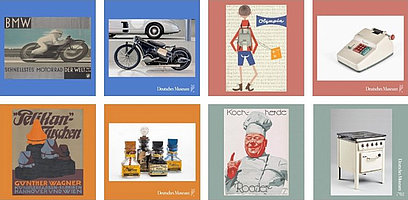
Münchner Stadtmuseum’s version of the
online exhibition “Product – Advertising”
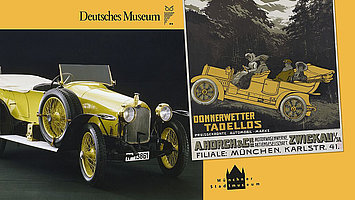
Deutsches Museum’s version of the
online exhibition “Product – Advertising”
Sources and Further Reading
- Bäumler, Susanne (Hrsg.): Die Kunst zu werben. Das Jahrhundert der Reklame. Ausst.-Kat. Altonaer Museum in Hamburg, Münchner Stadtmuseum. Köln 1996.
- Doosry, Yasmin (Hrsg.): Plakativ! Produktwerbung im Plakat 1885-1965. Ostfildern 2009.
- Gerber, Sophie / Lorkowski, Nina / Möllers, Nina: Kabelsalat. Energiekonsum im Haushalt. München 2012.
- Horstmann, Theo / Weber, Regina (Hrsg.): „Hier wirkt Elektrizität“. Werbung für Strom 1890 bis 2010. Essen 2010.
- Reinhardt, Dirk: Von der Reklame zum Marketing. Geschichte der Wirtschaftswerbung in Deutschland. Berlin 1993.
Henning Rader is a historian and head of the Advertising Collection at Münchner Stadtmuseum. He has curated many exhibitions of cultural history.
Bernhard Wörrle is an ethnologist and has led the digital collection management system at Deutsches Museum since 2013. His current research focus is colonial artifacts.
Keywords
Categories
Plan Your Visit
Opening hours
Interim exhibition What the City. Perspectives of Munich in the former armory
Tuesday – Sunday 11am – 7pm
Free Admission
Filmmuseum München – Screenings
Tuesday / Wednesday 6.30 pm and 9 pm
Thursday 7 pm
Friday / Saturday 6 pm and 9 pm
Sunday 6 pm
The rest of the museum is currently closed due to the general refurbishment.
Contact
St.-Jakobs-Platz 1
80331 München
Phone +49-(0)89-233-722370
E-Mail stadtmuseum(at)muenchen.de
E-Mail filmmuseum(at)muenchen.de
Cinema ticket reservation Phone +49-(0)89-233-724150